
Ashley Zelinskie
The Weight of Space
SOLO X300 Broome Street, NYC
Open: Nov 20, 2026 – Jan 15, 2027
See the monumentsOpening RSVP + DetailsLeaving Earth requires an extraordinary expenditure of force. It also carries a weight that cannot be measured in mass: collective ambition, the unknown, human lives, public trust, and the consequences of what we send beyond our atmosphere. Through marble, bronze, data-altered images, and moving digital works, Ashley Zelinskie brings that weight into view at a time of profound change in the course of space exploration. An endeavor long defined by national programs, private companies are now transforming the pace and scale of mission launches, while shaping decisions that will determine who can access space, whose ambitions lead its exploration, and what remains above us for generations.
Success and failure run through the history of this industry, but their costs are unequal. Publicly funded missions carry the expectations of taxpayer accountability and decades of preparation, while private ventures have accelerated development through repeated testing and the destruction of experimental vehicles. Innovation, expenditure, discovery, and loss occupy the same field. Holding wonder alongside responsibility, The Weight of Space asks what we are willing to risk, who carries the consequences, and what kind of future is built from our desire to reach beyond Earth.
Here, objects made for weightlessness become monuments in stone, preserving the human labor and vulnerability of the preceding era of spaceflight. Launch imagery transforms into forms resembling stars, galaxies, and stellar explosions: the forces that carry our instruments into space begin to resemble the universe those instruments reveal. A recorded heartbeat makes the distance intimate, while an increasingly crowded orbital sky gives individual departures a cumulative scale. The exhibition moves between remembrance, the urgency of the present, and a future already taking shape above us.
Monuments
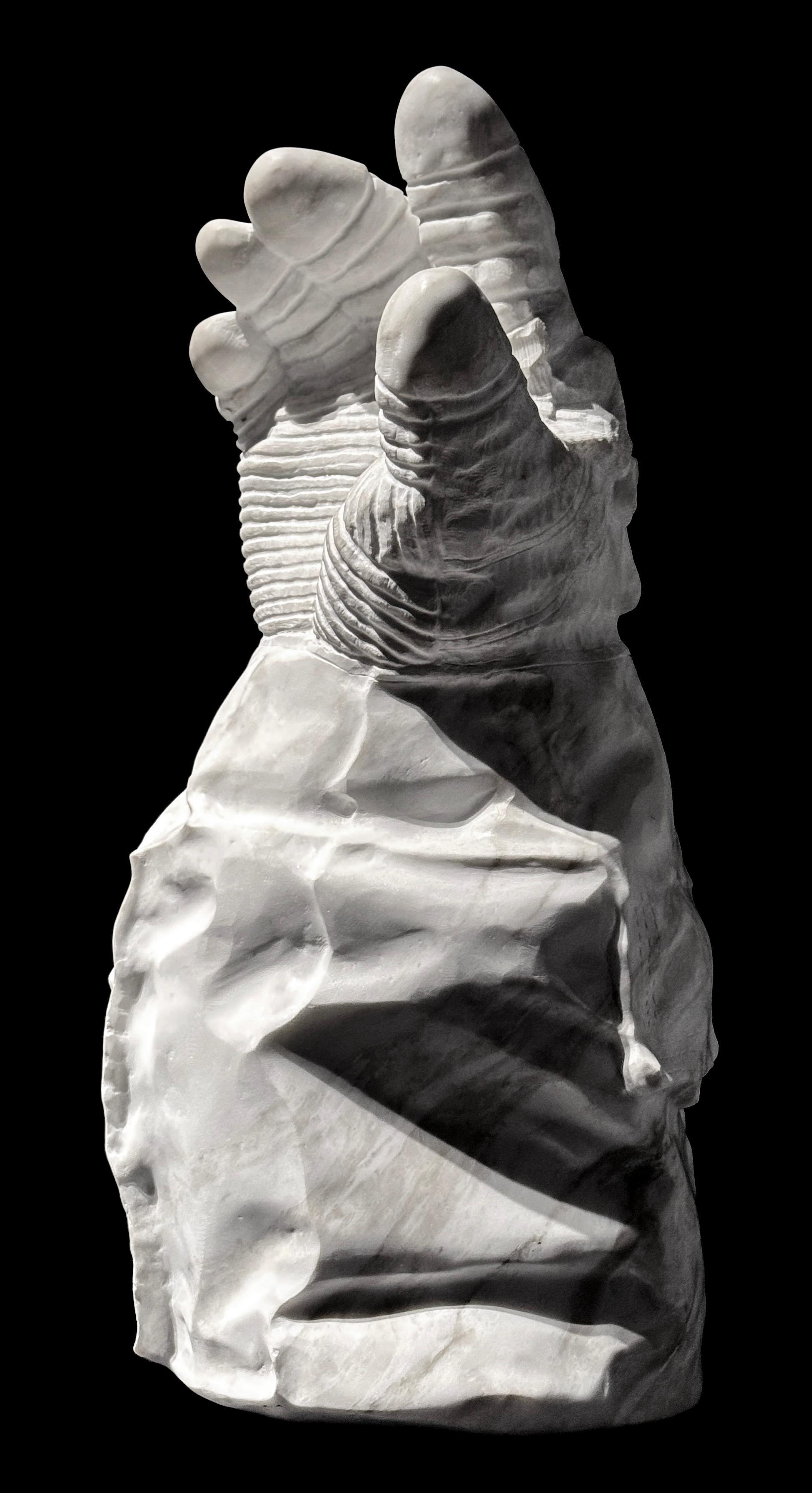
Carved in marble, spacewalking equipment takes on a physical weight that echoes its historical significance, turning objects made for weightlessness into monuments in stone. Soft fabric becomes rigid, a flexible tether becomes still, boots designed never to touch the ground become firmly earthbound.
Developed through Zelinskie’s collaboration with retired NASA astronaut Mike Massimino, who famously repaired the Hubble Telescope over multiple spacewalks, her works preserve the equipment and gestures of his years servicing the Hubble Space Telescope. His career gives the history of the Space Shuttle era a human scale, recording the labor, vulnerability, and ingenuity behind its achievements.
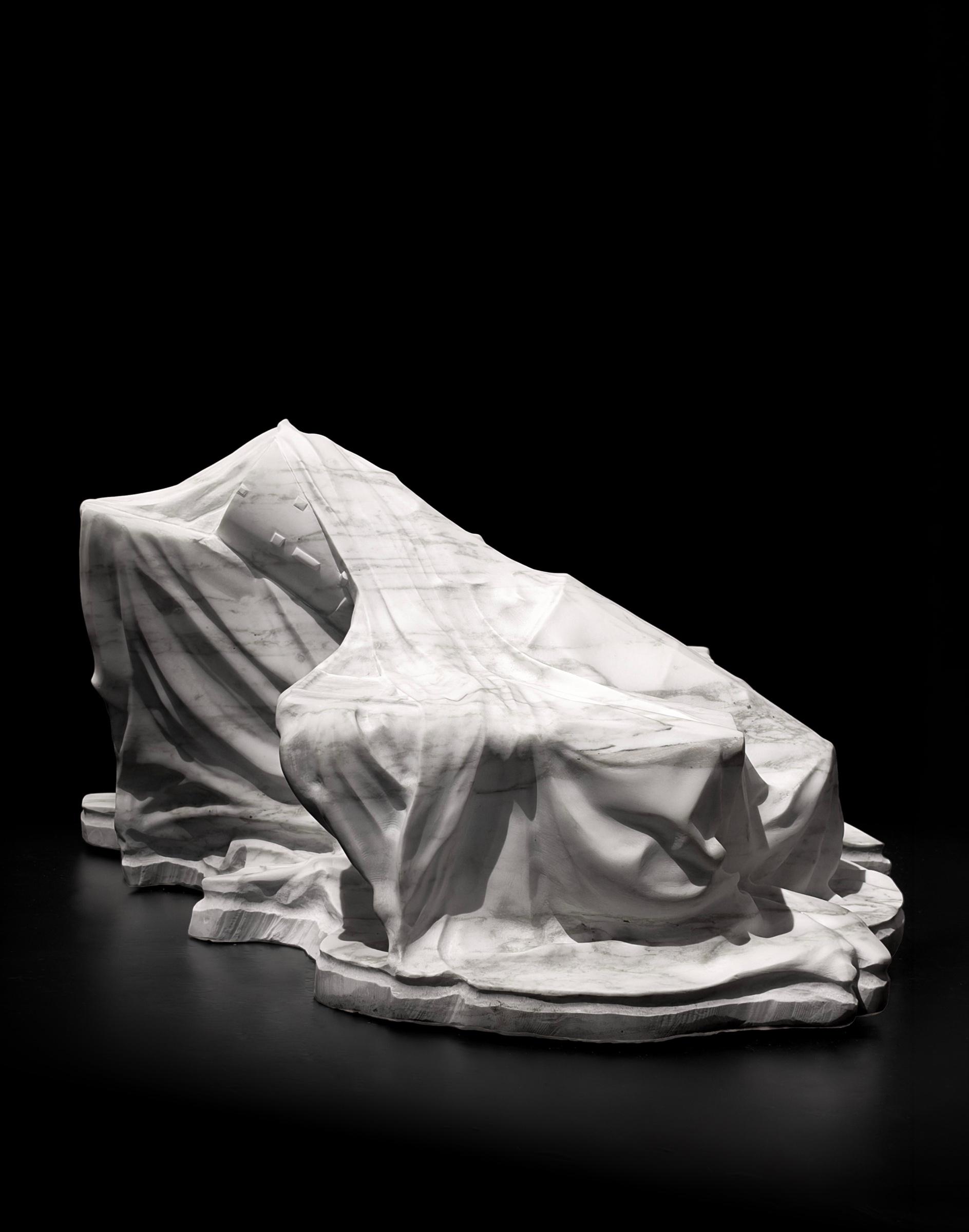
Veiled Hubble, 2026
Unique Calacatta Oro marble sculpture (+AP), signed
21 × 16 × 15 in
Sold
In the tradition of the veiled sculpture, from Sanmartino’s transcendent Cristo Velato (1753) to Strazza’s Veiled Virgin and Monti’s ethereal marble drapery, the veil has long served as sculpture’s most paradoxical gesture: the act of concealing makes the hidden more present, more weighted, more real.
Zelinskie brings this centuries-old language into collision with the Hubble Space Telescope, the instrument that arguably did more to unveil the universe than any object in human history — and yet one that launched into the cosmos already veiled, its primary mirror ground to the wrong prescription, its first images soft and aberrant, a tool of revelation that could not yet see.
To drape Hubble in marble is to honor that original blindness as much as the eventual clarity; it is also to acknowledge that the telescope is now aging into an eventual monument itself. Hubble is no longer the eye at the edge — it is slowly ceding its role to newer instruments, its legacy calcifying into history. The marble veil does what veils have always done in art: it marks the sacred, it mourns what is ending, and it insists that what lies beneath is worth preserving.
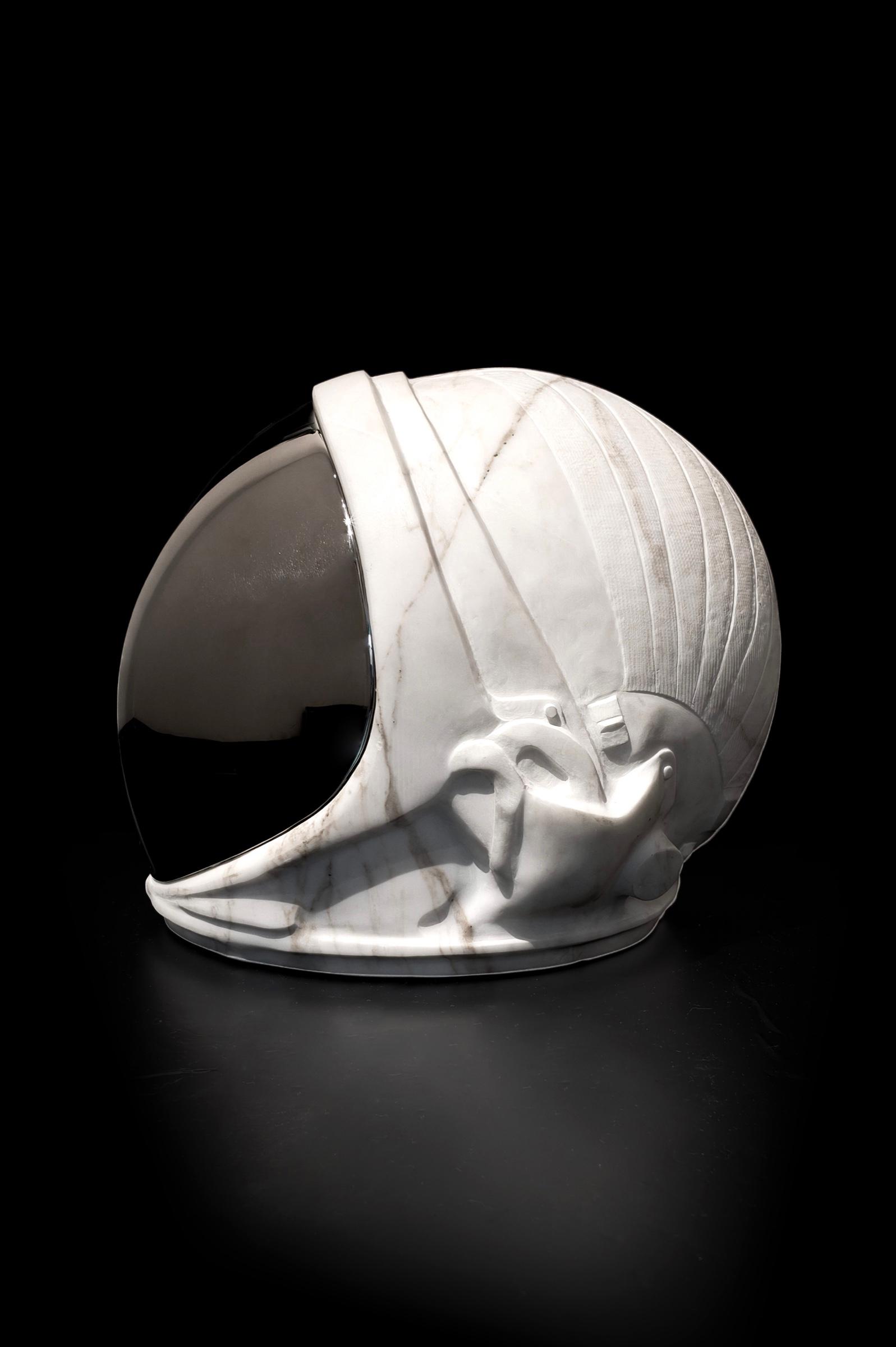
Reentry Helmet, 2025
Unique Calacatta Oro marble sculpture (+AP), signed
14 × 11 × 13 in
Sold
Carved from marble and fitted with a 3D-printed visor plated in chrome, this sculpture transforms the most critical piece of astronaut survival gear into a study in material contrast. This helmet shields a human body during reentry, falling through the atmosphere at 17,000 miles per hour, rendered permanent and still in stone, with a mirrored visor that holds only the identity of those who observe it.
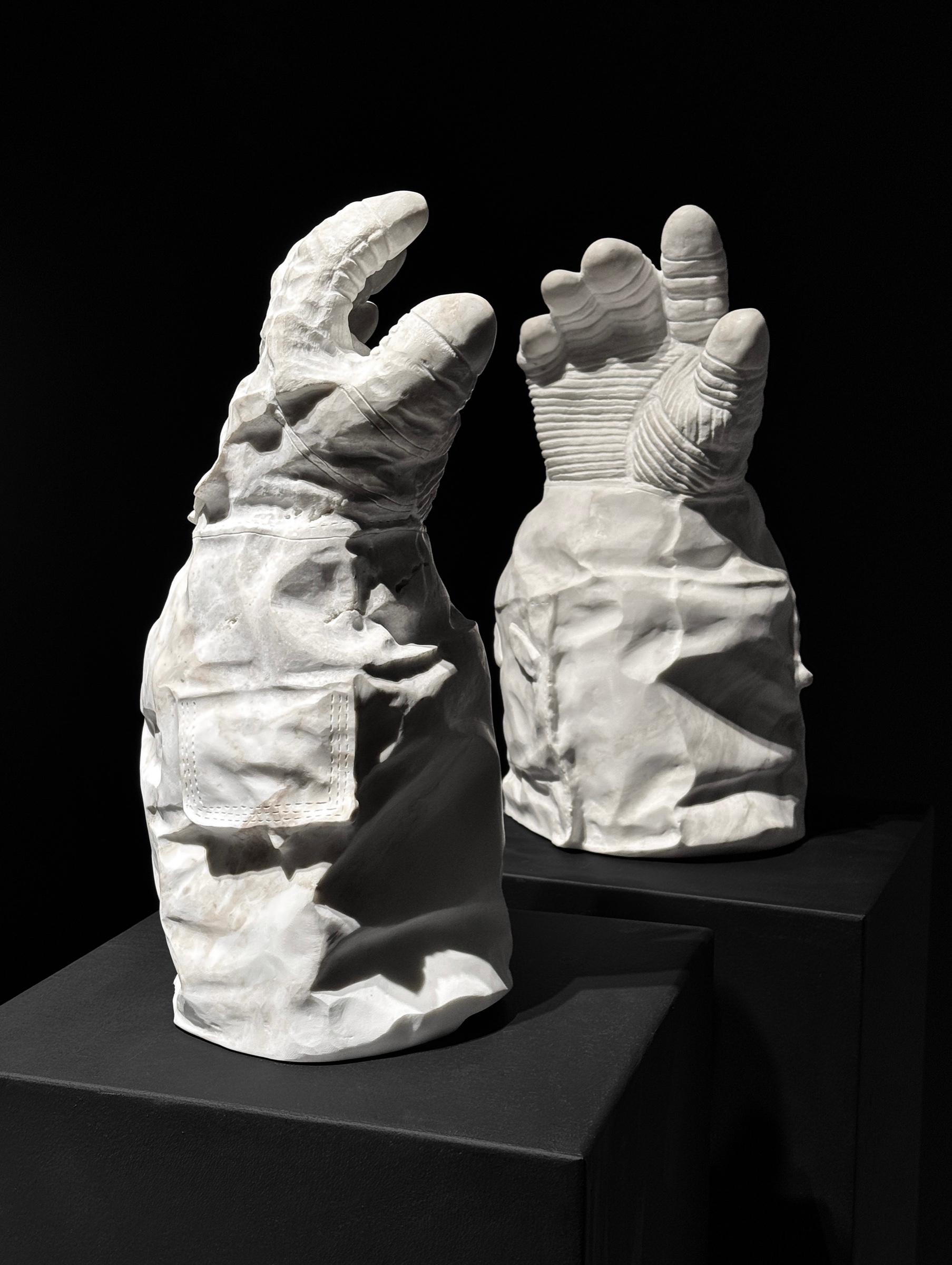
Astronaut Gloves (AP), 2022
Unique Calacatta Oro marble sculpture AP, signed
16 × 8 × 7 in each
Sold
Self-standing monuments to the heavy, dexterous labor performed by astronauts in their mission to research and explore outer space, this pair is informed by 3D scans of NASA spacesuit gloves and inspired by those worn by Mike Massimino during his Hubble Space Telescope missions. The challenge of maneuvering small and delicate tasks is felt in the scale and weight of this piece – a reflection of the stone-like texture and color of spacesuit gloves – while conversely, the heavy, rigid stone looks soft and smooth like the fabric of the original.
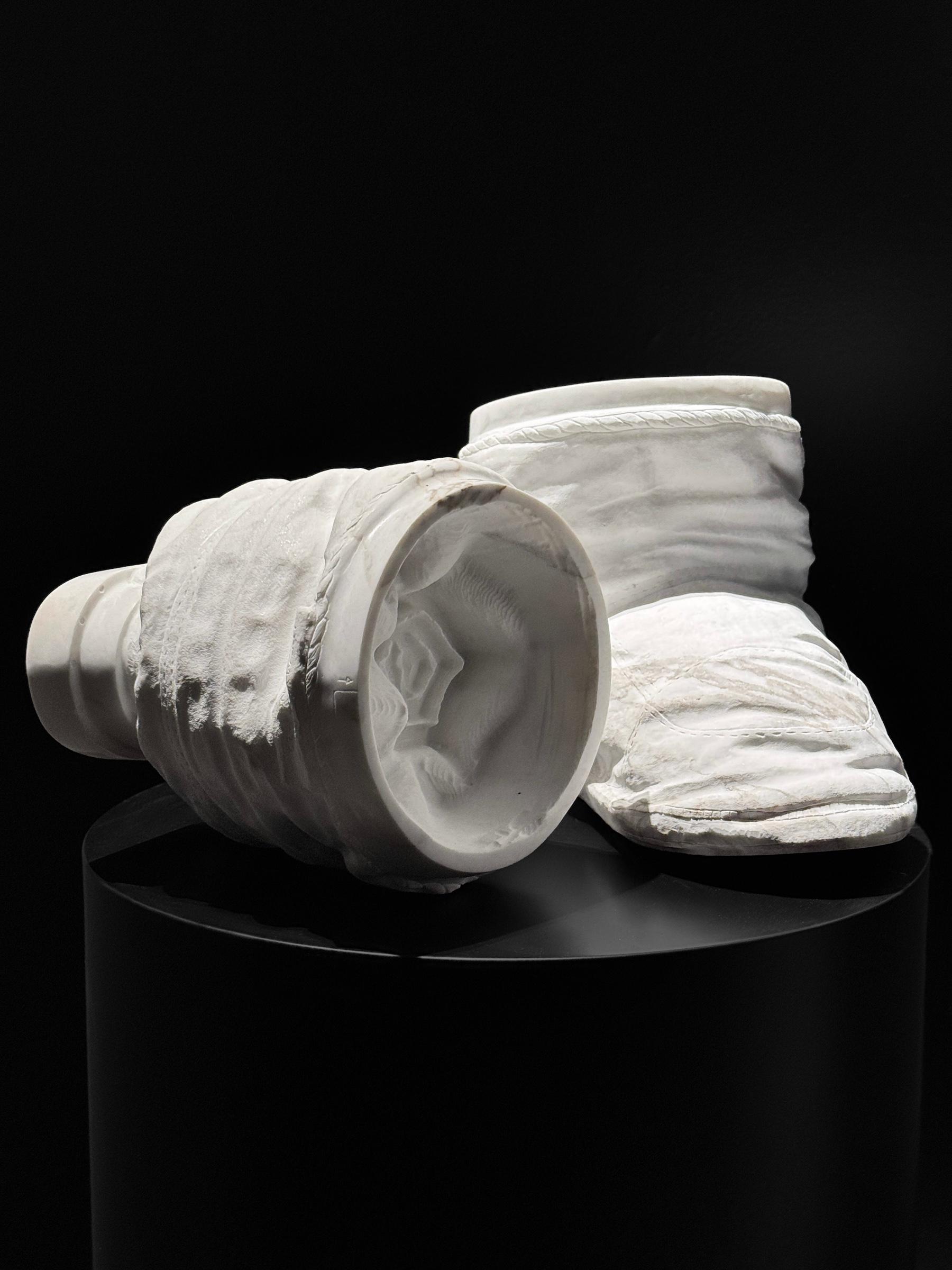
Astronaut Boots, 2024
Unique Calacatta Oro marble sculpture (+AP), signed
9.5 × 19.5 × 14 in
Sold
Made for feet that never touch the ground, these boots find their footing on a telescope in orbit. Drawing on 3D scans of NASA spacewalking boots and Mike Massimino’s experiences servicing Hubble, their heels are designed to secure an astronaut at a worksite on the telescope, anchoring the body so the hands can work. Rendered in marble, they give weight to the soft airtight fabric and an unfamiliar kind of standing.
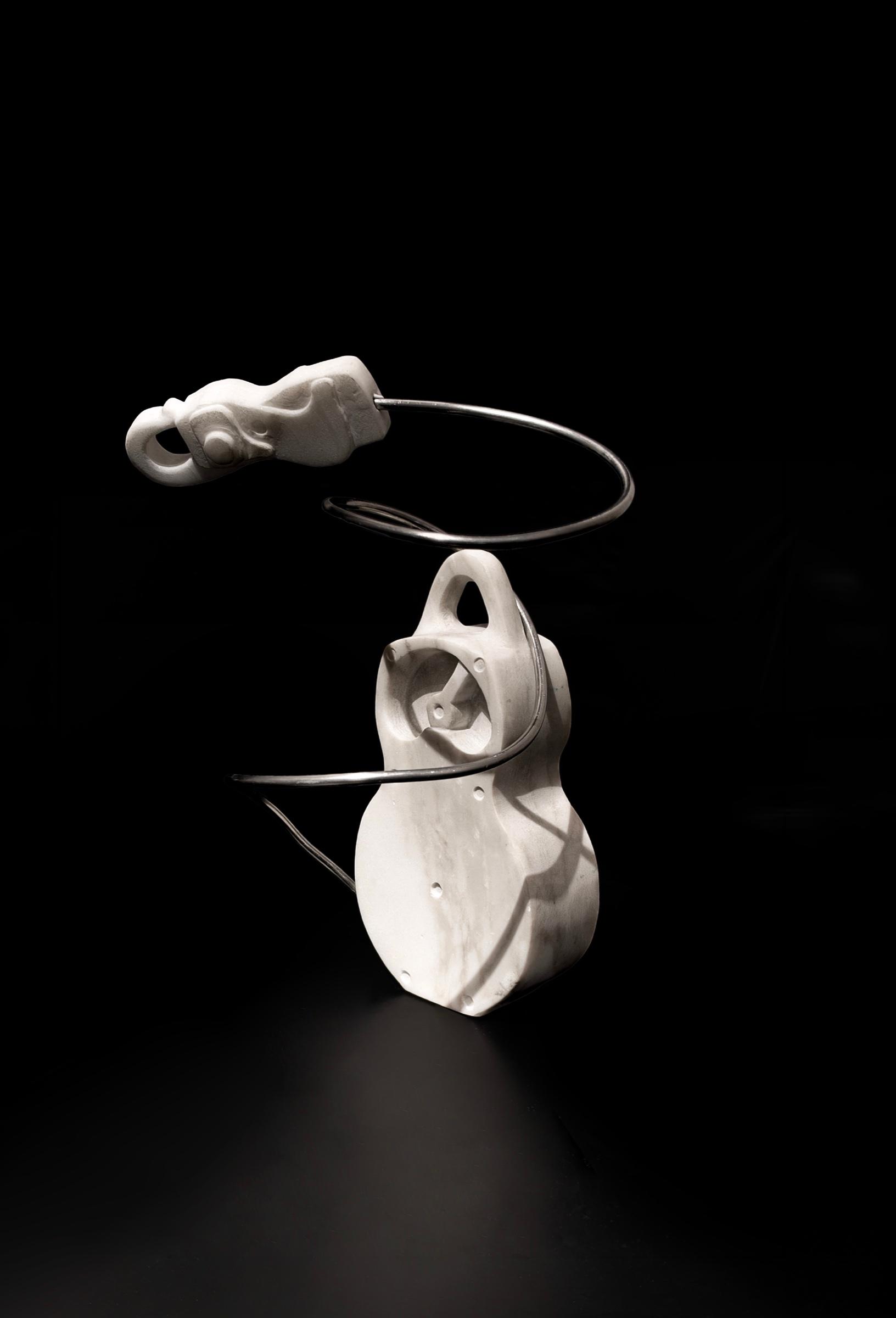
Tether, 2023
Unique Calacatta Oro marble sculpture (+AP), signed
12 × 8 × 5 in
A tether is the ultimate guard against the void. Designed to keep a suited astronaut securely connected to a spacecraft, it represents the vital physical connection between Mike Massimino’s body and the Hubble Space Telescope during his STS-125 spacewalks, allowing him to let go with his hands long enough to work. Without a tether, the repair is impossible. Rendered in marble, the tether’s fundamental nature is inverted: a thing designed for movement and yield is fixed. The cable that flexes in zero gravity becomes static wire. What keeps a body from drifting is now itself still, forever.
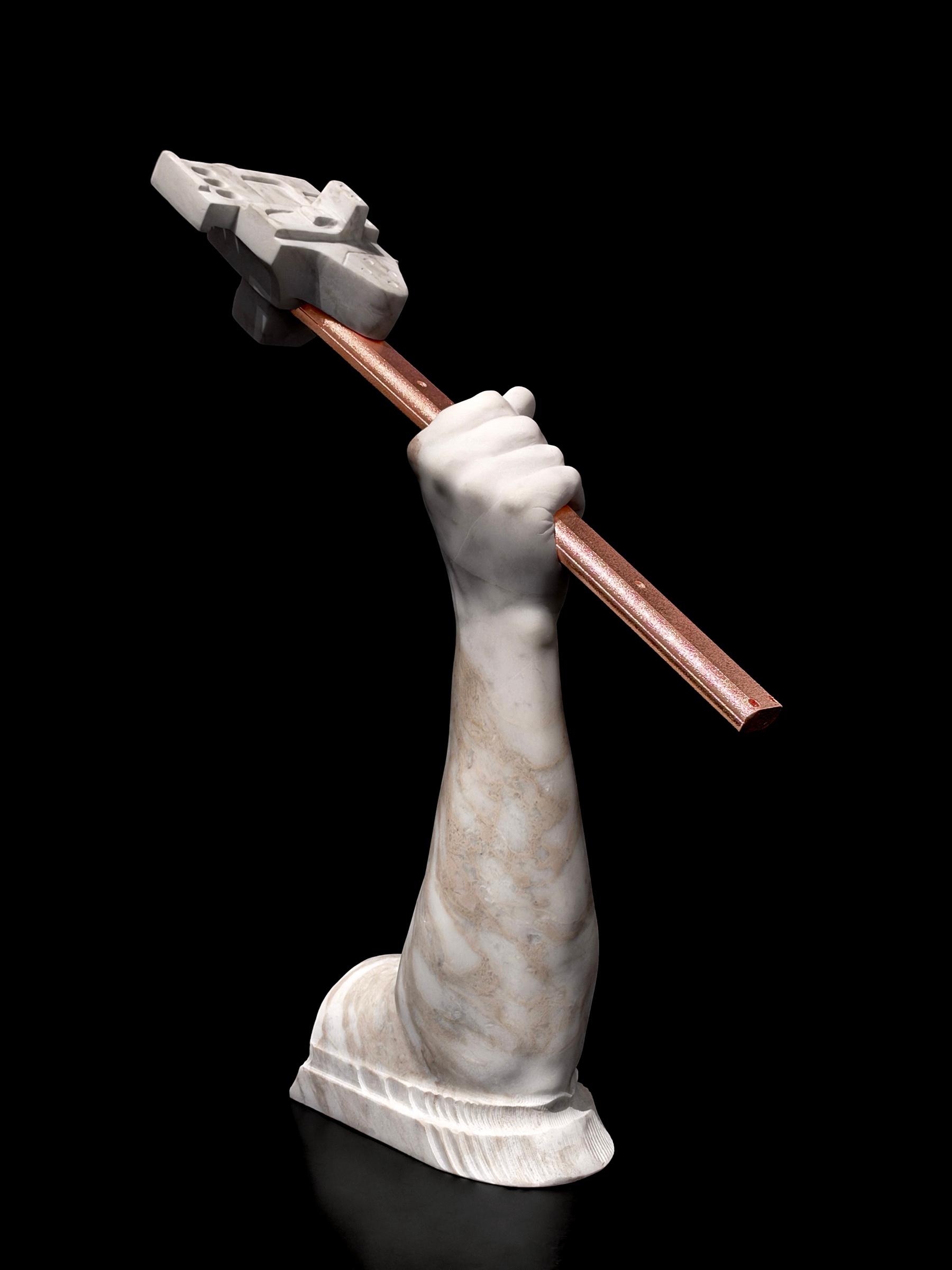
Hubble Handrail, 2025
Unique Calacatta Oro marble sculpture (+AP), signed
19.5 × 19.5 × 8 in
A marble sculpture made from a scan of Mike Massimino’s arm and hand holds a copper replica of the handrail he tore from Hubble during a servicing mission. Revealing the human body beneath the spacesuit, the work gives an intimate scale to an extraordinary act of repair — a moment when NASA’s carefully rehearsed procedures gave way to risky physical improvisation. Preserved in stone, the gesture honors the person whose strength and human judgment made the mechanical repair possible.
Ashley Zelinskie
The Weight of Space

Opens Nov 20 – Jan 15
300 Broome Street, New York